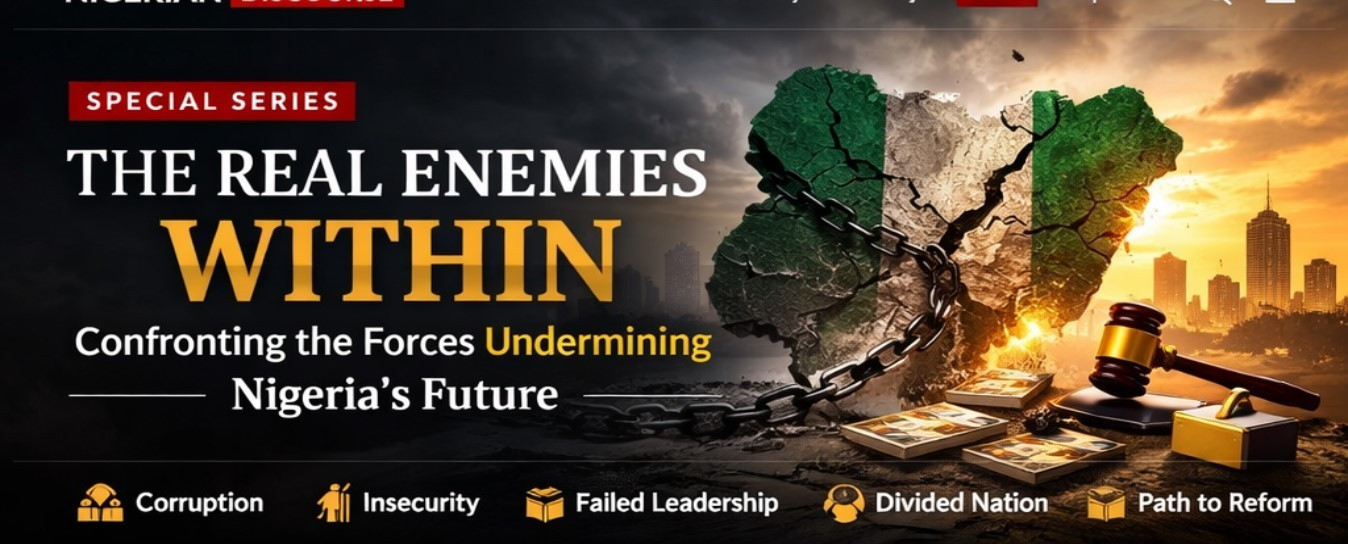
By Nigerian Discourse Editorial Team. | April 2026 | 12 mins read
Why Nigeria's Greatest Threat is not External - But Internal.
Overview
A deep dive into the systems , behaviours, and failures sabotaging our nation - and the path to national renewal
KEY HIGHLIGHTS
SERIES ROADMAP
Week 1
Corruption & Power
Week 2
Insecurity Crisis
Week 3
Faith &Division
Week 4
Diaspora & Reputation
Final
A New Nigeria ?
Nigeria has no shortage of critics, both within and outside its borders. Often, we are quick to point fingers at colonial legacies, foreign interests, or global conspiracies. While external factors have played their roles in our history, the most persistent and damaging enemies of Nigeria are largely homegrown. They are not faceless forces; they are systems, behaviors, and choices—sometimes embodied by individuals, sometimes enabled by collective silence.
If Nigeria must move forward, we must first be honest about what is holding her back.
Corruption: The Enemy Within the System
Corruption remains Nigeria’s most entrenched enemy. It cuts across public and private establishments, and it thrives among both the high and low cadres of society.
.At the top, corruption appears as inflated contracts, budget padding, diversion of public funds, and state capture by political elites. At the lower levels, it manifests as bribery, extortion, falsification of records, and the “something for the boys” culture that has become normalized.
Examples are everywhere:
A contractor paid billions for a road that is abandoned after clearing bushes.
A civil servant who will not move a file without a bribe.
A private company that evades taxes but demands government protection.
Corruption is not just stealing money; it is stealing hope, opportunity, and the future.
Interactive pause:
Ask yourself—when last did I refuse to give or take a bribe even when it inconvenienced me?
Image Saboteurs: Nigerians Who Debase Nigeria Abroad
Another enemy of Nigeria is Nigerians who habitually malign the country before international audiences.
These include:
Online and social media activists who exaggerate or misrepresent facts
Failed politicians who lost elections and now seek validation abroad
Diaspora influencers who profit from negativity
Well-intentioned but reckless commentators unaware of diplomatic and economic implications
Criticism is necessary. Demonization is destructive.
When every narrative about Nigeria abroad is chaos, genocide, and hopelessness, investors flee, opportunities shrink, and ordinary Nigerians suffer.
Secessionists and the Politics of Disintegration
Closely related are secessionist movements who, at every opportunity, portray Nigeria as irredeemable.
Some of them:
Lobby foreign governments to sanction Nigeria
Circulate graphic propaganda without context
Celebrate instability to justify their cause
While grievances may be real, deliberately seeking to destroy Nigeria’s image to force a breakup is not patriotism—it is national sabotage.
A Complicit Populace: Celebrating Corruption
Perhaps the most uncomfortable enemy to confront is the general populace.
Despite knowing that many politicians are corrupt:
Communities celebrate them with chieftaincy titles
Crowds hail them for sharing money looted from public funds
Voters condemn them privately but vote for them publicly
This contradiction sustains corruption.
If corrupt leaders had no followers, would they still thrive?
Criminal Ambassadors: Exporting a Bad Image
Another enemy of Nigeria is Nigerians who actively damage the country’s reputation abroad:
Fraudsters (419ers)
Drug traffickers
Cybercriminals
Their actions reinforce stereotypes, making it harder for honest Nigerians to:
Get visas
Secure jobs
Do international business
Every crime committed abroad under the Nigerian identity weakens the Nigeria brand.
Insecurity: A Nation Under Siege
Nigeria is bleeding from multiple insecurity fronts:
North East: Boko Haram and ISWAP insurgency.
North West: Banditry, mass kidnappings, and village raids.
North Central: Farmer–herder conflicts, militia violence, and land disputes.
South East: Separatist-linked violence, criminal gangs, and the collapse of trust between civilians and security agencies.
When citizens are unsafe in their homes, farms, schools, and highways, development becomes impossible.
Insincere Leadership: Politics Without Service
One of Nigeria’s gravest enemies is insincere leadership in public office.
A significant number of politicians enter politics not to serve, but to:
Accumulate wealth
Acquire immunity
Control power structures
Settle personal scores
This explains why some leaders will do anything—however sinister—to gain, retain, or recycle power. Electoral violence, judicial manipulation, ethnic incitement, and vote-buying are not accidents; they are strategies.
Many never intended to serve the people in the first place.
Question for readers:
If politics were truly about service, how many of today’s politicians would still contest?
Religious Activism and Weaponization of Faith
In Islam:
Extremist groups like Boko Haram exploit religious sentiments to justify violence, recruit followers, and delegitimize the Nigerian state.
In Christianity:
Some religious leaders have turned pulpits into: and morally guide society, has become another dangerous enemy when weaponized.
Financial enrichment centers through unaccountable prosperity preaching
Fierce political campaign grounds
Platforms for fear-mongering and sensationalism
Equally dangerous are those who reduce every criminal or terrorist act to religion, ignoring economic, political, and criminal dimensions. This reckless amplification has had serious consequences—one example being international narratives that portray Nigeria as a country that encourages “Christian genocide,” a claim echoed by foreign political figures like Donald Trump, largely driven by distorted and selective information.
Religion should heal Nigeria, not fracture it.
manipulation, ethnic profiling, and poor intelligence coordination.
Desperate Politicians and Manufactured Chaos
One of the most sinister enemies of Nigeria is the desperate politician.
Stories abound of:
Politicians sponsoring thugs to disrupt communities
Financing criminals to amplify insecurity narratives
Weaponizing violence to delegitimize opponents or governments
In some cases, already established criminal networks are induced, funded, or protected to worsen carnage—all in pursuit of power.
This is treason against the people.
The Almajiri System: A Neglected Time Bomb
The Almajiri system, though rooted in religious education, has become a major structural enemy due to mismanagement.
There is nothing wrong with religious learning. However:
Poorly regulated Almajiri practices have produced millions of out-of-school children
Many become vulnerable to exploitation, crime, and radicalization
They provide easy recruits for insurgents and bandits
Although practiced mainly in the North, its consequences—crime, insecurity, social instability—affect the entire country.
Nigeria cannot ignore this ticking time bomb.
Final Thoughts: The Mirror Test
Nigeria’s real enemies are not imaginary. They are real, visible, and often tolerated. Some wear suits. Some wear religious garments. Some hide behind activism. Others hide behind poverty or ignorance.
The most dangerous enemy, however, is our refusal to take responsibility.
Nigeria will not change until:
Corruption is despised, not celebrated
Leadership is demanded, not begged for
Religion is practiced with sincerity, not weaponized
Patriotism is defined by truth and responsibility, not noise
If Nigeria were a mirror, would you like what you see staring back at you?
The fight for Nigeria is not just against enemies out there—it is against the enemies we have allowed to grow within.